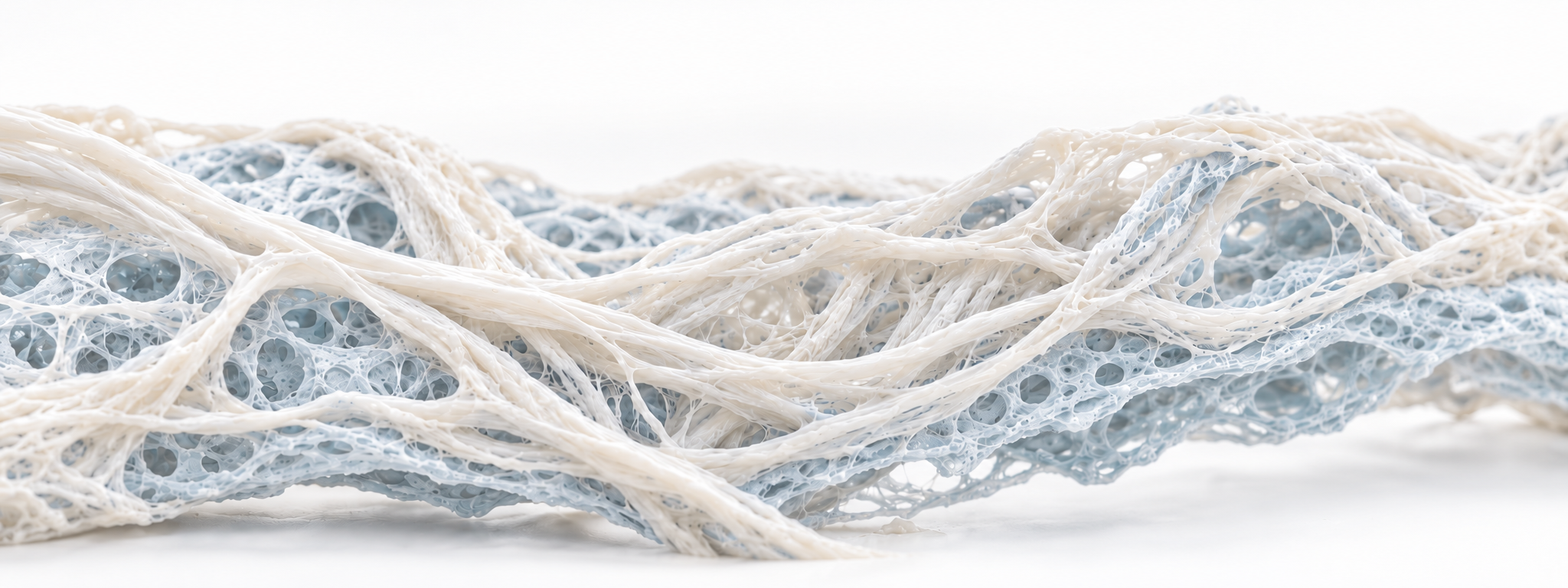
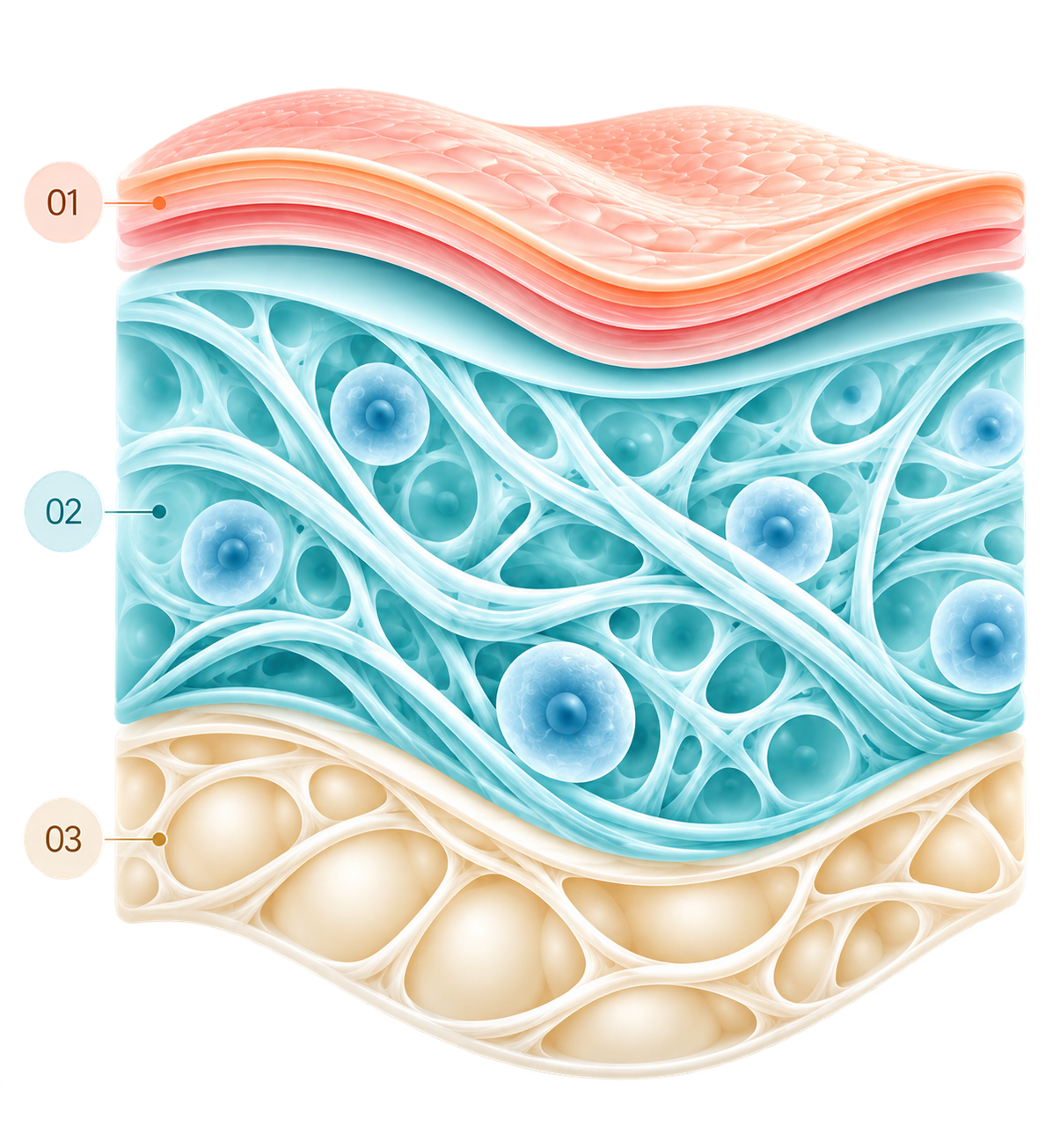
The Extracellular Matrix (ECM) is the three-dimensional biological environment surrounding cells. An Acellular Dermal Matrix (ADM) is processed to remove cellular components while seeking to preserve an organized dermal scaffold.
A structured acellular dermal matrix platform for professional regenerative and reconstructive contexts. Source, specifications, sterility and regulatory information are published only after verification.
Native-inspired architecture
Developed around preservation of extracellular-matrix structure.
Three-dimensional scaffold
An organized environment for matrix–tissue interaction.
Controlled information
Technical and regulated fields stay unpublished until verified.
Professional focus
Built for clinicians, researchers and qualified partners.
From dermal structure to regenerative scaffold
1
Dermal matrix
A naturally organized extracellular environment.
2
Controlled processing
A process designed around cellular-component removal.
3
Preserved architecture
A three-dimensional structural scaffold.
4
Tissue interaction
A framework for biological integration and remodeling.
Beyond Surface-Level Rejuvenation
Skin quality begins beneath the surface. Our scientific perspective focuses on dermal architecture and the extracellular environment that supports tissue organization—without making exaggerated anti-aging promises.
Certificates, clinical results and regulatory status are displayed only when supported by controlled source documents. General science is kept visibly separate from product-specific evidence.
Advanced Dermal Regeneration is a matrix-focused way of describing how dermal structure, extracellular-matrix biology and controlled biomaterial design can be considered together. This educational section explains the terminology used across Allograft.ca and separates general scientific background from product-specific evidence and authorized product information.
What the extracellular matrix contributes to dermal structure
The extracellular matrix, often abbreviated ECM, is the three-dimensional network that surrounds cells and contributes to the physical organization of tissues. In skin, the dermal environment contains structural proteins and associated molecules arranged in a complex architecture. General ECM science helps explain why regenerative biomaterials are often evaluated not only by their surface appearance but also by their internal structure, porosity, physical properties and interaction with surrounding tissue. These concepts are part of basic tissue biology; they do not, by themselves, establish the clinical performance of a specific commercial product. Product performance must be supported by product-specific testing, controlled documentation and, where relevant, clinical evidence.
What an Acellular Dermal Matrix (ADM) is
An Acellular Dermal Matrix is a dermal scaffold produced through processing intended to remove cellular components while retaining useful elements of the dermal matrix. Source tissue, processing methods and final properties can vary substantially between ADM products, so the term ADM describes a category rather than a single standardized material. When evaluating an ADM, healthcare professionals should rely on the current Instructions for Use, verified specifications, sterility information, storage requirements, regulatory status and evidence that applies to that exact product in their jurisdiction. Allograft.ca therefore keeps general educational science visibly separate from claims about ADM Plus until controlled product documentation is available for publication.
Why architecture is central to our regenerative biomaterial approach
Our site uses the phrase architecture-led design to describe a development philosophy: the organization of a biological matrix matters alongside its composition. A three-dimensional scaffold may be characterized through methods such as microscopy, histology, mechanical testing and other material analyses. Those measurements can help describe consistency and structure, but they should not be translated into guaranteed patient outcomes. Advanced Dermal Regeneration on this website therefore refers to a disciplined scientific framework for studying dermal matrices, not a promise of wound closure, scar elimination, age reversal or any other specific therapeutic result. Clinical decisions remain the responsibility of qualified professionals using authorized labeling and appropriate evidence.
Evidence, safety and professional decision-making
Regenerative and reconstructive products sit in a clinical and regulatory context that can differ by country. Availability, intended use, preparation, contraindications, warnings and supporting evidence should be checked against current market-specific documents. Allograft.ca is designed as a professional information environment: verified product data can be requested, scientific concepts are labeled as educational, and unverified certificates or performance claims are not presented as established facts. This distinction is especially important in medical and life-science communication, where useful educational content should improve understanding without replacing medical judgment, product labeling or local regulatory requirements.
Frequently asked questions about ADM and dermal regeneration
What does ADM stand for?
ADM stands for Acellular Dermal Matrix, a category of dermal scaffold produced through controlled processing intended to remove cellular components while retaining a structural matrix.
Is general extracellular-matrix science evidence for ADM Plus?
No. General ECM and ADM literature explains scientific background. Claims about ADM Plus require product-specific verified documentation and evidence.
Does Allograft.ca provide medical advice?
No. The public website provides educational and professional information and does not replace medical advice, Instructions for Use, product labeling or professional clinical judgment.
Where can professionals request current product information?
Healthcare professionals, researchers and qualified distribution partners can use the professional registration or contact pages to request verified, jurisdiction-specific information.
Independent scientific reading
These external references provide general scientific background on extracellular matrix biology and the ADM category. They are not presented as product-specific evidence for ADM Plus.